

Solution


Industry Spotlight


Watch our latest video case study!
Check out how Colibri's partnership with Nomo Fintech has transformed their approach to data
Learn more

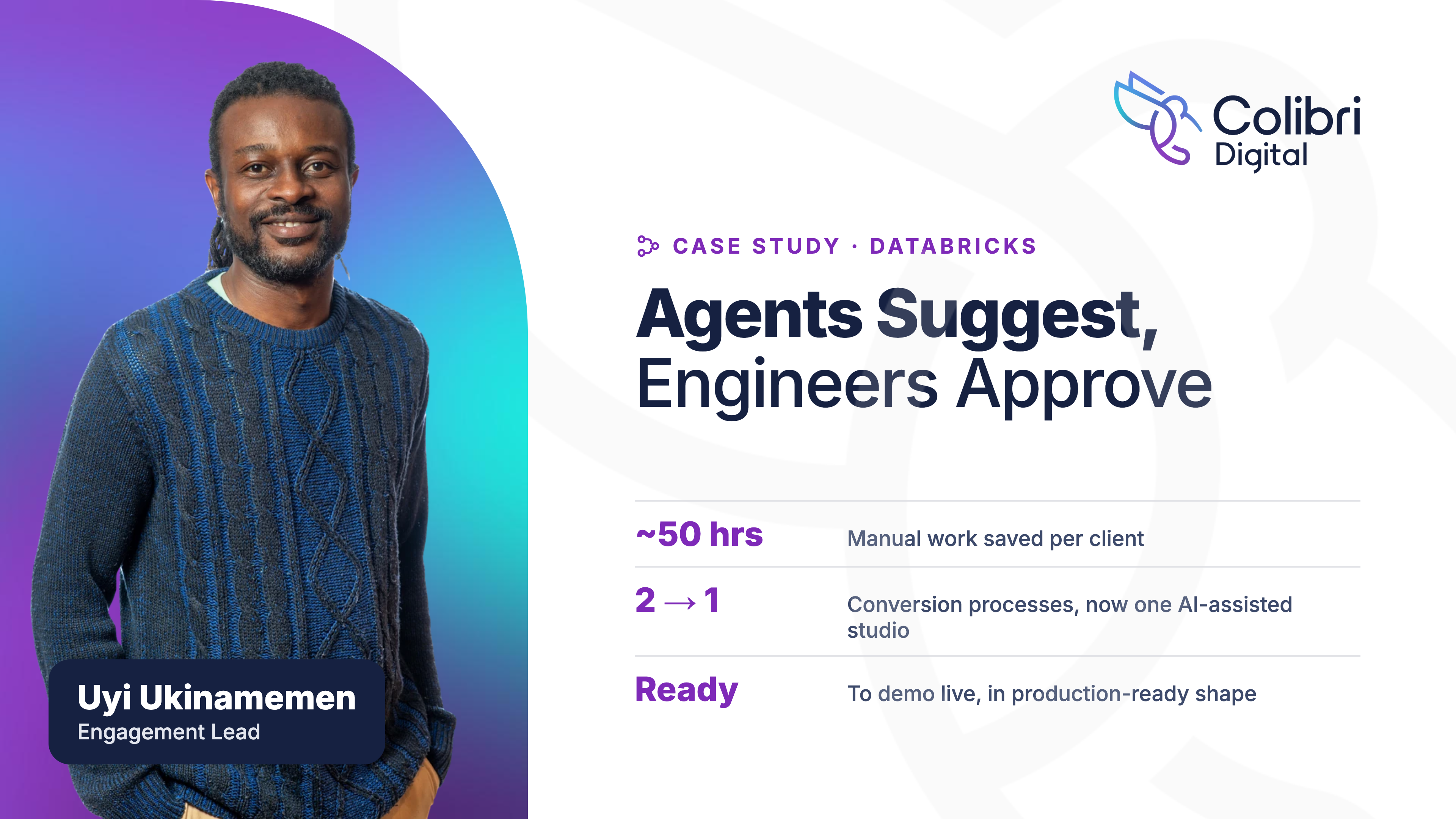
Our client builds software for a heavily regulated market, where accuracy and tight security matter as much as speed. Onboarding a new customer meant converting their data by hand in SQL and COBOL, and profiling a single customer's files took anywhere from 8 to more than 40 hours. With two disconnected legacy target platforms, only 10 to 15% of fields mapped easily. The rest needed one-off manual work.
That process relied on scarce SQL and COBOL skills and left a limited audit trail, which made it hard to repeat, and harder still to scale as the business grew.
So we built an agentic workflow that keeps people in control. AI agents suggest mappings, generate transformation code and validate outputs, while engineers review and approve at each gate. We delivered it iteratively, so the client could use and test it early.
The aim was to replace two siloed conversion processes with one AI-assisted data migration studio on Databricks: delivery controls first, then automated mapping, then a platform the client can demo and scale with confidence.
The project covered three core stages: target schema, ingest and profiling, and automated mapping. As requirements sharpened through end-to-end testing, we refined the work in focused increments.
Foundation and control. Approved data sits under version control with end-to-end audit lineage in Unity Catalog and Delta Lake, so every conversion can be traced. Databricks Asset Bundles and Azure Pipelines make each release repeatable.
Ingest and profiling. Ingestion and profiling run as independent workflows on Databricks Jobs, with Strands Agents on Databricks Model Serving reading source files from Amazon S3. That means a step can be rerun without redoing the whole conversion.
Mapping and automation. Automated mapping generates source-to-target code in an app on Databricks Apps, using Databricks Foundation Model APIs, with MLflow tracing and model registration in Unity Catalog, and some UI data held in Lakebase. All of it runs within role-based access, sandboxing and governance controls, and one process now produces outputs for both target platforms.
Next, we're extending the workflow to further stages of the conversion process, starting with a design workshop alongside the client's team.

No spam. Just the latest releases and tips, interesting articles, and exclusive interviews in your inbox every month.


Can’t find the answer you’re looking for? Please chat to our friendly team.


